

The GARF believes films are a core aspect of our history, our culture, our memory, and our future. Unfortunately, due to the nature of the material used in production, film is fragile.*
The GARF needs your help to preserve George’s work. Please contact us if you are aware of, or possess, any unreleased films, scripts, recordings, photographs, production materials, or other surviving elements connected to his work.
Preservation is not only the act of conserving but also of restoring and distributing. Preservation is therefore an interdisciplinary process! Equally important, preserving films is not just digitizing them. It includes the much more delicate art of restoring them as they were originally perceived.
For the first DVD transfer of Night of the Living Dead, George said, “The early prints were on toilet paper, and I’m used to seeing it all grainy. On the DVD, it’s all cleaned up, and somehow doesn’t look as spooky anymore.” Preserving the artist’s vision, intention, and creativity is our goal.
Thanks to your donations and the partnership with IndieCollect, in 2021, we were able to preserve and restore George’s “lost film,” The Amusement Park. The film, commissioned by the Lutheran Society, stars Lincoln Maazel as an elderly man who becomes disoriented and increasingly isolated as the pains, tragedies, and humiliations of aging in America are illustrated through his journey among roller coasters and chaotic crowds.
It also brings a new perspective to George’s early filmmaking days. “Although not a horror film in the traditional sense, this recruitment film is disturbing in its depiction of societal indifference to aging,” said Suzanne Romero, The GARF’s president and founder. “Even though it’s early in his career, it’s a fascinating look at the footprint of Romero’s cinematic style.”
When asked why this initially forgotten film was never discussed, George said, ”It was done in three days. Bing, bang, boom…done! It was nothing!” Fortunately, the GARF was able to bring it to a wider audience and continue elevating George’s legacy.
This was the first in what The GARF hopes will become a culture of preservation and restoration of works initially lost. Please donate to The GARF today to help us continue our mission. Also, don’t forget to sign up for our newsletter to learn more about our current projects and updates from the Horror Archives.
*More than half of all films made before 1950 have been lost, and a mere 10 percent of those produced in the US prior to 1929 have survived.
The Amusement Park
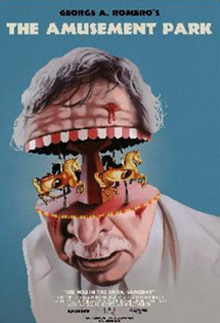
Romero’s The Amusement Park has been described as “a blunt yet visceral depiction of society’s treatment of the elderly” and “[a] portrait of how the US has long been a punishingly difficult place to live for those at the margins of its winner-take-all, work-till-you-drop capitalist infrastructure.”
Fifty years ago, Romero conjured this film, shooting it in the once-popular West View Park, which brought vintage fun and dancing to the region for 71 years before deteriorating and succumbing over time—ironically, given the film’s storyline, to the capitalist infrastructure of a shopping center!
The trailer for George’s film, The Amusement Park, brands it “the scariest film Romero ever made”, but this was not blood and guts and reanimated corpses. The Lutheran Service Society of Western Pennsylvania sponsored the film to raise awareness of the struggles faced by the elderly.
George succeeded in painting a shocking and nightmarish portrait of forgotten and discarded elders. “The more I see it, the more I realize how important this film is,” Suzanne Desrocher-Romero said. “The message that it evokes—that we dismiss our elderly, especially the ones who have no money—it’s a scary thing…. And the fact that we’re all gonna age, it’s all coming towards us, we need to snap out of it because we’re no exception…. It was a powerful moment when I saw it, and I’m glad that it’s out there and I’m glad people are seeing it.”
Following its restoration, The Amusement Park was released on Blu-ray by Yellow Veil Pictures on June 8, 2021, making this once “lost” Romero film available to a wider audience.
Romero’s Elegy / Expostulations
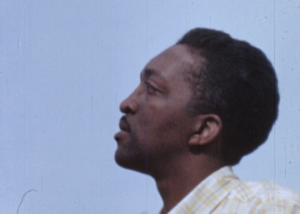
At 23 years old, George implored his uncle for a new Bolex camera. His uncle gave him $5,000 to purchase it. With his new friends, Russ Streiner and Richard Ricci, they shot a series of short films, all thought to have been lost. One of these films, now entitled Expostulations (formerly called Romero’s Elegy), was found and is being restored by the George A. Romero Foundation.
Expostulations is a 21-minute film shot in Pittsburgh in 1963. Richard Ricci plays one of the antagonists. Shot without sound or dialogue, the original intention was to add a soundtrack comprised of music and poetry, but the project was never completed.
In 2020, Ricci wrote the poem that has been added to the piece. Richard passed away 4 days after submitting the piece, which he had worked on for 9 months. The restoration team then hired Terry Alexander to narrate the poem.
Martin Comes Home
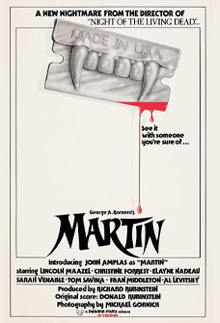
It all started when someone approached Kevin Kreiss, curator of the Living Dead Museum, with three mysterious reels labeled “Martin B&W“. The sellers claimed that the reels were George’s director’s cut, so naturally, there was much interest in validating the claim.
This artistic liberty to be who he was and lay it all out on celluloid meant everything to George, and Martin was his personal favorite amongst his films. So, the prospect that the film really did embody the director’s cut piqued the interest of everyone close to George.
Richard Rubenstein suspected that the film was not the director’s cut, but rather a first assembly, the editor’s first cut of the entire movie. Regardless, the sellers were convinced that they had something special, and the Foundation agreed.
“Martin is also a fan favorite,” said Suz Romero, “and the fans were excited! We were afraid that some collector would buy the film but not be able to show it due to not owning the IP, so the film would just be shown in someone’s basement or something like that. But the film really belongs in the archive, and I beseeched the sellers’ lawyers to accept our offer to get the film.”
The initial offer was declined, and the University Library System at the University of Pittsburgh, which are the guardian of the George A. Romero Archival Collection, stepped in to help negotiate. A second offer was rejected, and the sellers decided to put the film up for auction at Julian’s Auction House in Los Angeles. Suz immediately registered.
“We were ready to pool money to get the film,” she expressed, “but our angel, Greg Nicotero, said he would bid.” Anticipation and anxiety escalated, and the film price rose to $35,000. Greg bid $40,000, and then… the stars aligned with George.
“No one else bid!” exclaimed Suz. “It was one of the best days of my life. It’s truly extraordinary because part of what I do is to try to protect George and his work as much as I can.”
And, thus, Martin is coming home to Pittsburgh, where the University library will restore the film, enabling it to be studied and preserved for all of us in the fright-loving masses.